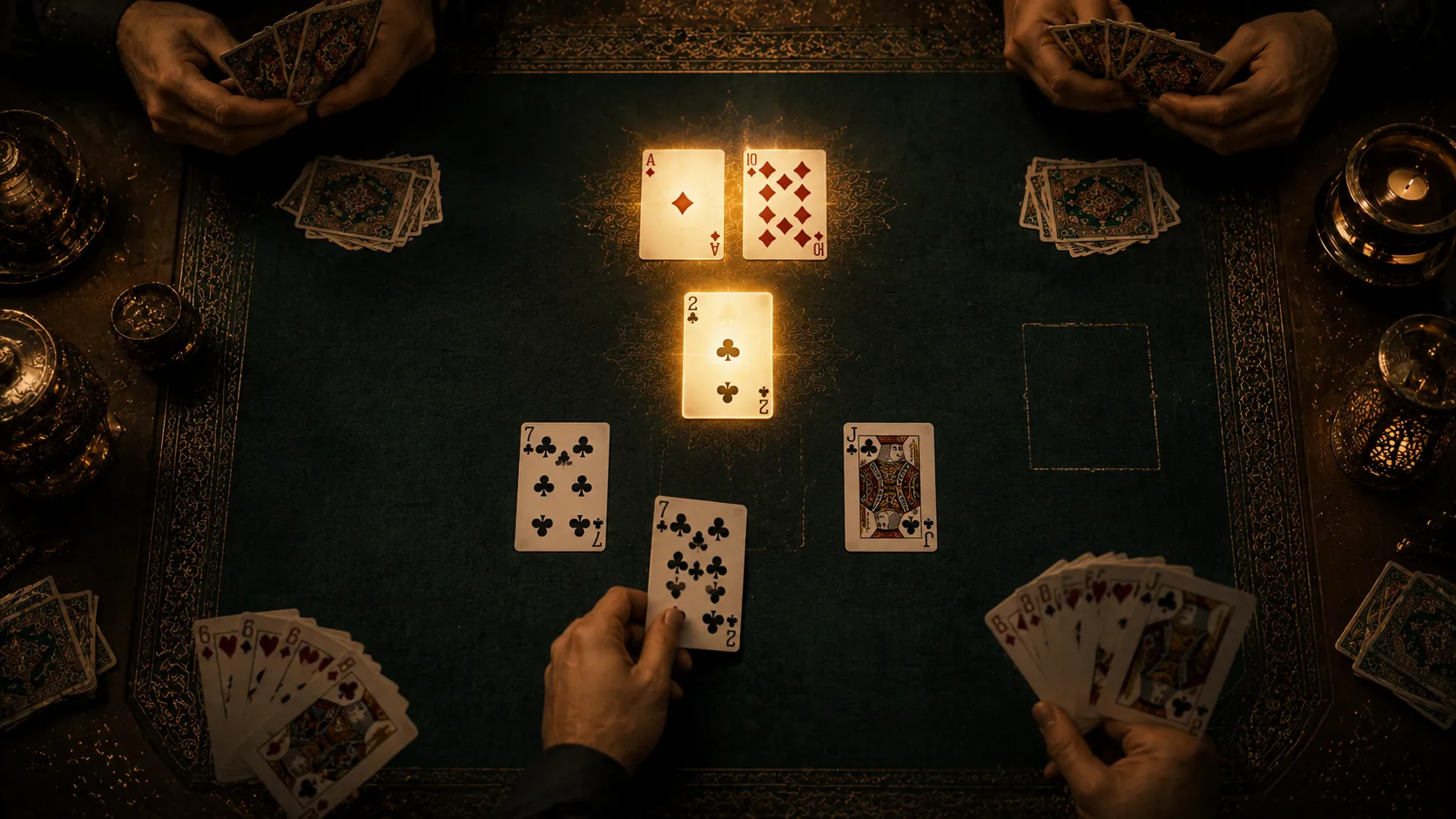
Chahar Barg (Four-Berg), also known as Pasoor, Yazdah, or Haft Khaj, is one of the most popular Iranian card games. It is typically played with two players but can also accommodate three or four players (in teams of two).
The game uses a standard 52-card deck with no jokers. Unlike trick-taking games like Hokm, the goal in Chahar Barg is to collect cards from the table by making combinations that sum to 11.
Other Names
- Pasoor: Originally the main name of this game
- Yazdah (Eleven): Because cards are collected by making sum 11
- Haft Khaj (Seven Clubs): Collecting seven Clubs gives 7 important points
- Chahar Barg (Four Leaves): Because each player receives four cards per deal
Setup and Dealing
Cards are thoroughly shuffled. Each player receives four face-down cards, and four cards are placed face-up on the table. Play begins from the player to the dealer's right, usually counter-clockwise. After all players have played their four cards, another four cards are dealt to each player — but no new cards are placed on the table. This continues until all 52 cards are played.
Card Collection Rules
Number Cards (Ace through 10)
Number cards collect table cards by making a total of 11, including the played card. For example, playing a 7 means you must pick cards summing to 4 from the table. Ace counts as 1 when making combinations.
King and Queen
A King can only capture another King from the table. A Queen can only capture another Queen. These cards cannot form sum-11 combinations.
Jack (Soldier)
The Jack (called Sarbaz/Soldier) is a unique card. When a player plays a Jack, it captures all number cards (Ace through 10) and all other Jacks on the table — but not Kings or Queens.
Soor (Sweep)
If a player clears all cards from the table in one move, they score a Soor (sweep). Each Soor is worth 5 points.
- Clearing the table with a Jack does not count as a Soor
- Soor cannot be scored in the final deal of a round
- After reaching 50 points, no more Soors can be taken
- Soors from opposing players cancel each other out (only the net difference scores)
Scoring
After all 52 cards are played, scores are calculated. The base total per round (without Soors) is 20 points:
- Haft Khaj (Seven Clubs): 7 points — for collecting 7 or more Clubs
- 2 of Clubs: 2 points (separate from its role in Haft Khaj)
- 10 of Diamonds: 3 points — the most valuable individual card
- Each Ace: 1 point
- Each Jack (Soldier): 1 point
- Each net Soor: 5 points
The match typically continues until a player or team reaches 62 points.
Strategic Tips
- Prioritize Haft Khaj: 7 points is huge — always prefer taking Clubs when possible
- Track 2 of Clubs and 10 of Diamonds: The two most valuable cards in the game
- Use Aces wisely: They are the only direct way to capture a 10 — the Ace is invaluable
- Don't waste the Jack: Save it for when valuable cards are on the table
- Small cards are dangerous: They can be easily captured in many combinations
- Prevent opponent Soors: If table card values sum to 10 or less, an opponent might sweep
- Remember the last taker: Remaining cards go to whoever last collected
Common Mistakes
- Miscalculating 11 — the played card also counts in the sum
- Capturing a King or Queen with a number card — they only capture their own kind
- Thinking a Jack sweep counts as a Soor — clearing the table with a Jack is not a Soor
- Neglecting Clubs — Haft Khaj gives 7 independent points
- Wasting the Jack too early
- Discarding the 10 of Diamonds without a plan
Summary
Chahar Barg (Four-Berg) may seem simple at first, but success requires memory, calculation, Jack management, awareness of scoring cards, preventing opponent sweeps, and planning for the final collect. Players who remember which important cards have been played and think beyond their current move have a much higher chance of winning.