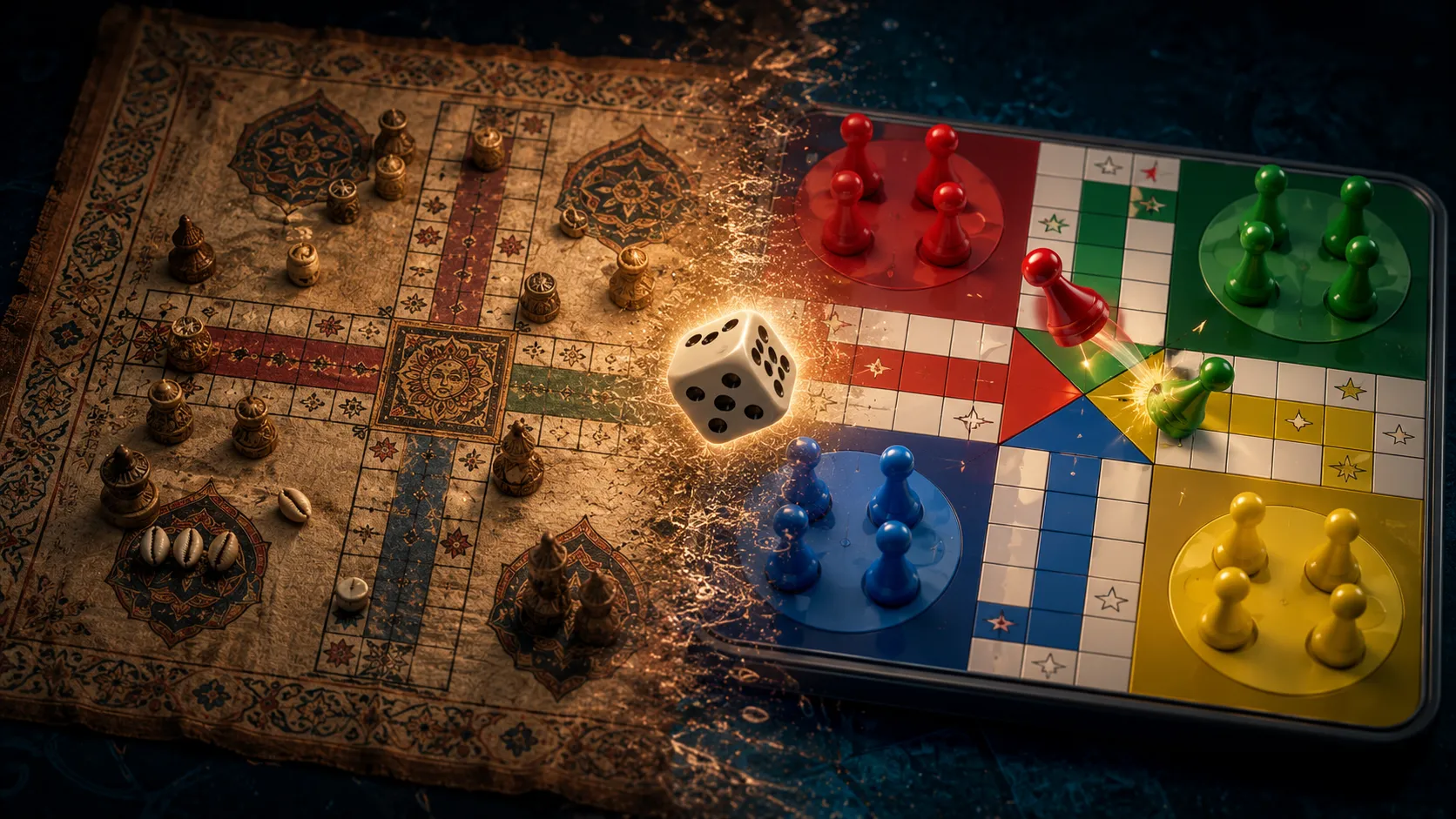
Manche (known internationally as Ludo) is one of the most well-known family board games in Iran. It is usually played by two to four players, each with four pieces of the same color. The goal is simple: each player must move their four pieces from the starting area onto the board, complete a full lap around the board, and reach the home area before their opponents.
Pieces are moved by rolling a single six-sided die. Luck plays a significant role, but decisions such as choosing the right piece, hitting an opponent's piece, escaping danger, and getting closer to the goal mean Manche is not just a game of chance. The version known worldwide as Ludo has relatively simple and standardized rules. The common Iranian version belongs to the same family but differs in some details — safe squares, how pieces enter, the three-6 rule, blocking the path, and finishing conditions.
Game Overview
| Players | 2 to 4 |
| Pieces per player | 4 |
| Movement tool | One six-sided die |
| Common colors | Red, Blue, Green, Yellow |
| Goal | Get all four pieces to the home area |
| Entry condition | Rolling a 6 |
| Hitting opponent pieces | Yes |
History of Manche
Roots in India
Ludo and modern Manche trace back to a family of ancient Indian games, the most famous of which is Pachisi. Pachisi was played on a cloth cross-shaped board. Players moved their pieces along four arms of the board and used small cowrie shells or diece-like tools to determine moves. The name "Pachisi" comes from the Hindi and Urdu word for twenty-five, as the highest possible score from throwing shells was 25 in some versions.
Pachisi in the Mughal Court
Pachisi became an important court entertainment during the Mughal Empire. Historical accounts speak of Emperor Akbar's interest in board games, and a large playing surface at Fatehpur Sikri is associated with Pachisi. In a famous account, pieces were sometimes human-sized and real people moved across large board squares.
Birth of Modern Ludo
In the 19th century during the British presence in India, Pachisi's principles were brought to Europe and a simplified version emerged. This simplified game was registered in England in 1896 under the name Ludo. The word Ludo comes from Latin, meaning "I play." Today the game is known by different names worldwide: Ludo in Britain, Parcheesi in America, Parchís in Spain, Mensch ärgere Dich nicht in Germany, and Manche in Iran.
Where Does the Name "Manche" Come From?
The common Persian name "Manche" likely derives from the beginning of the German name Mensch ärgere Dich nicht, which roughly means "Don't get angry, man!" — referring to the frustration when an opponent hits your piece just before you reach the goal.
Board Layout
- Starting area (Base): Located in the four corners, where each player's four pieces begin
- Entry square: Each color has a specific square for entering the main path
- Main path: The shared path where all pieces move after entering
- Home column: The colored path leading to each player's goal area
- Home: The final destination — pieces here can no longer be hit
Standard Ludo Rules
Setup
Each player chooses a color and places their four pieces in their base. All players roll the die; the highest roller starts. Play proceeds clockwise.
Entering the Game
A player must roll a 6 to bring a piece from the base onto the board. The piece is placed directly on the entry square, and the player rolls again for the 6 bonus. If all pieces are in the base and the player doesn't roll a 6, their turn ends without any move.
The 6 Bonus
Rolling a 6 grants an extra turn. The player first moves the piece, then rolls again. Rolling a 6 also allows entering a new piece or moving an existing one six squares.
Three Consecutive 6s
In many modern versions, if a player rolls 6 three times in a row, their turn ends — the third 6 move is not made and play passes to the next player. Some stricter versions void all moves made in that three-roll chain.
Moving Pieces
The player chooses one movable piece and advances it exactly the number shown on the die. The die result cannot be split among multiple pieces. If no piece can move, the turn is forfeited.
Hitting Opponent Pieces
If a player's piece lands exactly on a square occupied by an opponent's piece, the opponent's piece is sent back to its base and must re-enter by rolling a 6. Passing over an opponent's piece is generally allowed — only exact landing causes a hit.
Safe Squares
A safe square is where a piece cannot be hit. Safe squares may be marked with a star, circle, different color, or special symbol. The number and position of safe squares vary between board designs.
Block (Blockade)
In many versions, two pieces of the same color can occupy the same square and form a blockade. Opponent pieces cannot land on or pass through a blockade.
Home Column and Finishing
After completing a full lap, the piece enters its colored home column. Only pieces of that color may enter, and pieces here cannot be hit. An exact roll is required to reach the final home square. The first player to get all four pieces home wins.
Iranian Manche Differences
Iranian Manche shares the same board and basic goal as Ludo, but there is no single official ruleset — families and cities may play with their own house rules.
- Entry: Rolling a 6 is required to bring pieces in. Players are not limited to finishing one piece before entering another
- 6 bonus: Rolling a 6 usually grants an extra roll. In some Iranian groups, hitting an opponent or reaching the goal also gives a bonus roll
- Three 6s: Purely conventional — penalties range from turn loss to voiding all moves in the chain
- Hitting: Exact landing hits the opponent. The entry square is usually safe. Two common rules: the entry square is completely safe, or a newly entered piece hits any opponent already there
- Blockade: Two same-colored pieces may form a blockade. Some Iranian players don't use blockades at all
- Finishing: An exact roll is usually required. If the roll exceeds the distance, the piece cannot move
Player Modes
- 2-player: Each player chooses one color, usually opposite sides for balance. In some versions, each player controls two opposite colors (eight pieces)
- 3-player: Three players each take one color; the fourth remains unused
- 4-player: The most common and competitive mode with all four colors active
- Team play: Opposing players are teammates. Win conditions vary between players finishing individually, helping a teammate after finishing, or the team winning when the first member finishes
Key Strategies
- Activate all pieces: Moving only one piece is risky — having multiple pieces on the board gives more options and splits risk
- Consider the 6-square gap: If an opponent is 1-6 squares behind you, they can hit you on their next turn
- Use safe squares: Safe squares are preferable when available, but over-staying slows you down
- Hit at the right time: Hitting is not always best — if your piece becomes vulnerable after hitting, it may be a weak move
- Manage the home column: Order of entry matters, especially when passing through your own pieces is not allowed
- Guard the blockade: A blockade near an opponent's entry square is very powerful
- Protect pieces near the goal: Losing a piece that has almost completed a full lap is very costly
Common Mistakes
- Moving only one piece throughout the game
- Not bringing in new pieces, using all 6s for a single advanced piece
- Ignoring opponent distances before moving
- Hitting without checking your own vulnerability afterward
- Forgetting the exact roll requirement for the final square
- Not clarifying the three-6 rule before play
- Assuming all colored squares are safe
- Misunderstanding the blockade rule
Pachisi vs Ludo vs Iranian Manche
| Feature | Pachisi | Ludo | Iranian Manche |
|---|---|---|---|
| Origin | India | England | Family from Ludo tradition |
| Board shape | Cross-shaped cloth | Square, four-colored | Square, four-colored |
| Movement tool | Shells or traditional diece | One six-sided die | One six-sided die |
| Pieces per player | Varies | Four | Four |
| Local rules | Highly varied | Relatively standardized | Highly varied |
Online Manche
The arrival of Manche on mobile phones and online platforms has given this classic game a new form. In digital versions, diece are rolled automatically, illegal moves are blocked, and rules are enforced automatically. The most important aspect of designing online Manche is clearly explaining which ruleset is used, since Iranian players may have grown up with different family rules.
FAQ
- Where did Manche originate? The roots trace back to Pachisi in India
- What's the difference between Manche and Ludo? Same basic structure, but Iranian Manche has locally varied rules
- How many players? Usually 2 to 4
- What number is needed to enter a piece? 6
- Can two same-colored pieces share a square? Depends on the version
- Is an exact roll required to reach home? Yes, in standard rules
Summary
Manche is one of the most popular family board games, with roots tracing back to Pachisi in India. The main difference between Ludo and Iranian Manche is that Ludo has a more standardized ruleset, while Manche is played with varying house rules across different families and regions. Manche has simple rules but deeply tactical decisions. A player who brings pieces into the path in a balanced way, measures opponent distances, uses safe squares, and knows when to attack or flee will have a good chance of winning — even with average diece rolls.