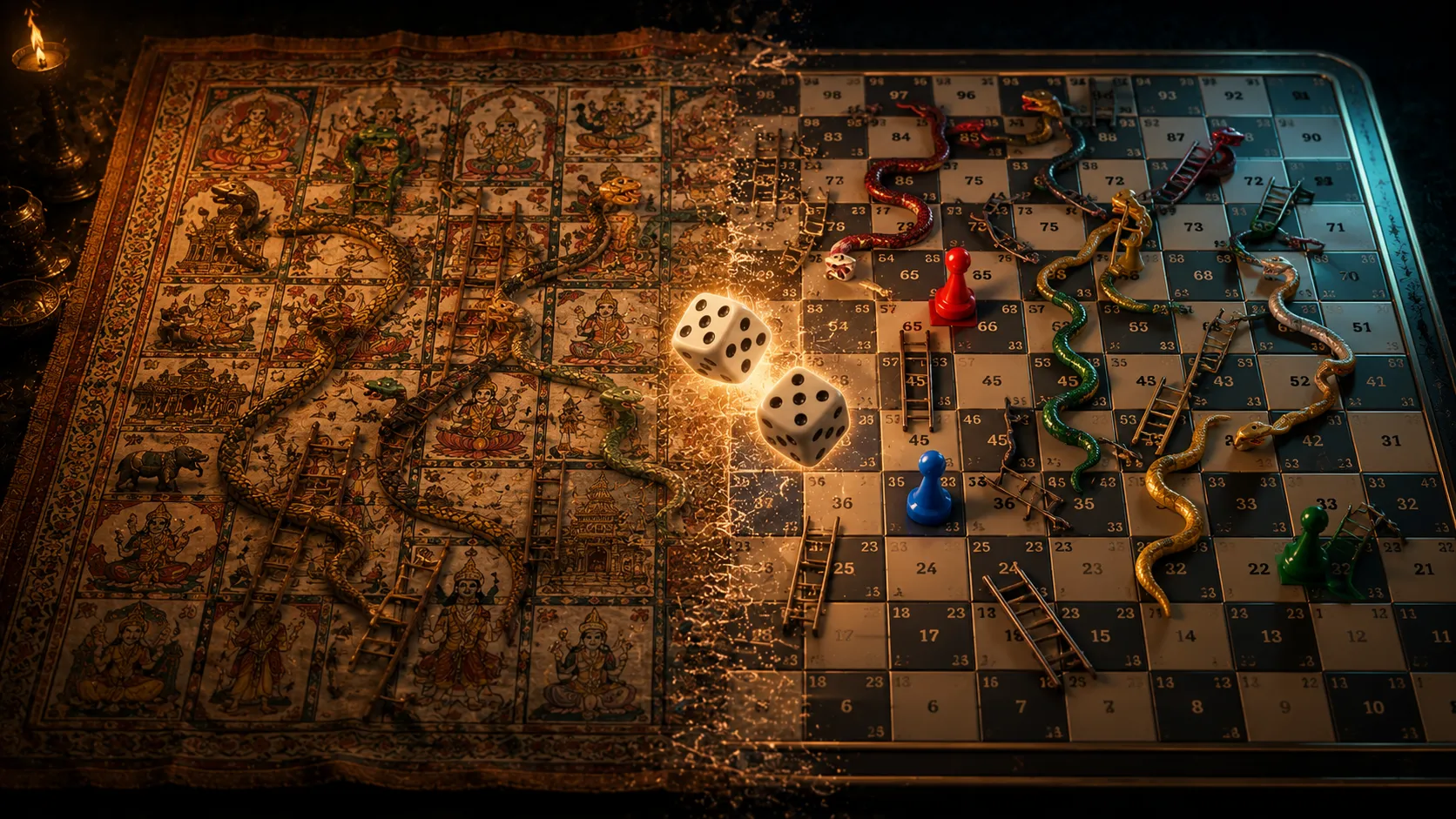
Snakes and Ladders is one of the most well-known board games in the world. Almost everyone has played it at least once as a child. The rules are very simple: each player has one piece. By rolling a die, the piece moves across the board. If it lands on the bottom of a ladder, it climbs to a higher square. If it lands on a snake's head, it slides down to the tail. The first player to reach the last square wins.
The intriguing fact is that Snakes and Ladders was not originally created for children's entertainment. The early version of this game in ancient India was an educational and moral game designed to teach concepts like honesty, humility, generosity, greed, anger, and the consequences of human behavior. Snakes symbolized moral downfall and ladders represented spiritual progress.
History of Snakes and Ladders
Birth in India
Snakes and Ladders traces its roots to India. The earliest known versions were called Moksha Patam and Gyan Chaupar. These games were not designed merely for entertainment — they were tools for teaching moral, philosophical, and religious concepts to children. On these boards, each ladder represented a virtue and each snake represented a sin or moral weakness.
Meaning of Snakes and Ladders in Early Versions
Snakes symbolized behaviors that lead a person astray: lying, greed, pride, jealousy, anger, and selfishness. If a player landed on a square representing one of these traits, the snake would pull them down. Ladders, on the other hand, represented virtues: honesty, generosity, humility, kindness, faith, and charity. Landing on these squares would quickly advance the player. The game's message was that good deeds shorten the path to growth.
From Moral Education to Entertainment
In the 19th century, the game was brought from India to Europe by the British. During this transition, most religious concepts were removed while the snakes and ladders remained. The rules were simplified and the game became geared toward children. It was published in England under the name Snakes and Ladders and later spread to many countries around the world.
Snakes and Ladders in Iran
There is no exact record of when the game entered Iran, but it likely arrived in the second half of the 20th century alongside other Western board games. The Iranian version follows essentially the same standard global rules, and most families know it as one of their earliest childhood games.
Equipment Needed
- A Snakes and Ladders board
- One six-sided die
- One piece for each player
The number of players is usually between two and four, but more can join.
The Board
The most common Snakes and Ladders board has 100 numbered squares, several snakes, and several ladders. Play starts from square 1 and the goal is to reach square 100. The numbering is typically arranged in a zigzag pattern.
Rules
Starting the Game
All players roll the die. The player with the highest roll starts. In the standard version, all pieces start directly on square 1. In some local variations, a player must roll a 1 or 6 to enter the board.
Moving the Piece
On each turn, the player rolls the die and moves their piece exactly the number shown. If it lands on the bottom of a ladder, it climbs up. If it lands on a snake's head, it slides down. Then play passes to the next player.
Ladder Rule
If a piece lands exactly on the first square of a ladder, the player is immediately moved to the top of that ladder with no extra roll needed. This move is mandatory.
Snake Rule
If a piece lands on a snake's head, it must immediately slide down to the tail of that same snake. This rule is also mandatory.
Passing Over Snakes or Ladders
A snake or ladder is only activated when a piece lands exactly on its starting square. If the piece merely passes over it, nothing happens.
Reaching the Final Square
In the standard version, a player must reach square 100 with an exact roll. If the roll exceeds the remaining distance, the piece does not move. In some family versions, the excess causes the piece to bounce back from the final square, but this is a house rule.
End of Game
The first player to reach the last square wins. If players want to determine second and third place, the game continues.
Is Snakes and Ladders Pure Luck?
Compared to games like chess, Hokm, or backgammon, Snakes and Ladders has almost no strategic decisions. The piece's movement is entirely determined by the die, and the player usually has no choice in the path. However, modern and digital versions sometimes add features like multiple pieces, special cards, or unique abilities that introduce an element of decision-making.
Different Versions
- Classic version: One piece per player, one die, 100 squares, fixed snakes and ladders
- Children's version: Shorter snakes, more ladders, cartoon images, simpler rules
- Educational version: Some schools use Snakes and Ladders to teach concepts like hygiene, environment, and traffic rules
- Digital version: Online play, tournaments, leaderboards, various dice, characters, themes, and visual effects
Interesting Facts
- Snakes and Ladders has been played in its modern form worldwide for over a hundred years
- Its original version was created for moral education, not entertainment
- Almost every country has its own version of the game
- Children can learn the rules in just a few minutes
- Many educational psychologists consider this game suitable for teaching counting, turn-taking, patience, and accepting defeat
FAQ
- Where did Snakes and Ladders originate? Ancient India, from games like Moksha Patam and Gyan Chaupar
- What is the goal? To move your piece from square 1 to the final square before other players
- What happens when you land on a ladder? Your piece immediately climbs to the top
- What happens when you land on a snake? Your piece slides down to the tail
- Do you need an exact roll to reach the last square? Yes, in the standard version
- Is there skill involved? The classic version is almost entirely luck-based, but modern versions may add new rules
Summary
Snakes and Ladders is one of the oldest board games in the world, with roots in ancient India. Originally designed to teach moral concepts — ladders representing virtue and snakes representing the consequences of wrongdoing — it evolved over time as it spread to Europe and became the simple, entertaining game we know today. Its easy rules, short playtime, and suitability for all ages have kept Snakes and Ladders one of the most beloved family games in the world for over a century.