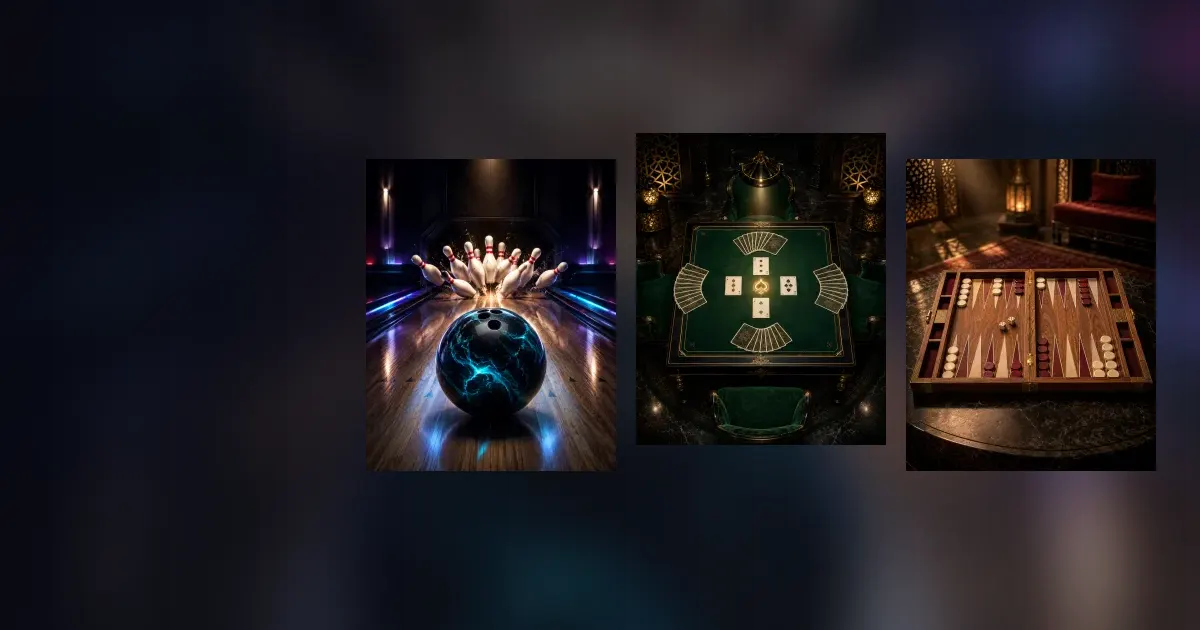
If you want an Iranian online game that carries both a childhood memory and today's excitement, the problem is usually the same: a separate app to install for every taste. AsNard solves that with one platform — thirty games across five families, on a single account, with no download and entirely inside the browser, from backgammon and Hokm to 3D bowling and mafia played with real voice.
This page is the roadmap: every family, the games in it, how many players each one takes, roughly how long a round lasts, and a link to that game's own page. If you are new here, start at "Where do I start?".
The five game families on AsNard
The games are grouped by what they ask of you, not by how they look:
- Card and Pasoor: card memory, reading your opponents and working as a pair
- Board and logic: calculation, probability and decisions made on full or incomplete information
- Skill and action: hand timing, accuracy and control — most of them in 3D, with physics simulated on the server
- Party and social: talking, persuading and guessing, usually with voice chat
- Open world and live: a world that stays where you left it after you log out
Iranian card games
Seven games in this family — the most popular part of the platform: the same games people gather around a Persian deck for, with the complete rules rather than a simplified version.
| Game | Players | Round length | Level |
| 4-Player Hokm | 4 (2 against 2) | 10 to 25 minutes | Intermediate to professional |
| 2-Player Hokm | 2 | 8 to 15 minutes | Intermediate to professional |
| Shelem | 4 (2 against 2) | 15 to 40 minutes | Professional and calculation-heavy |
| Chahar Barg | 4 | 5 to 15 minutes | Easy to intermediate |
| 2-Player Chahar Barg | 2 | 5 to 12 minutes | Easy to intermediate |
| Texas Hold'em Poker | 2 to 6 | 10 to 45 minutes | Advanced |
| Uno | 2 or 4 | 5 to 15 minutes | Easy and fast-paced |
One practical note: on AsNard, "Pasoor" is the gateway to these games rather than a separate title of its own — from the Pasoor page you can walk straight into any of these tables.
Board and logic games
Eight games with no cards in sight; here the game is about the dice, the board and the order of your moves.
| Game | Players | Round length | Level |
| Backgammon | 2 | 8 to 20 minutes | Intermediate to professional |
| Manche | 2 to 4 | 10 to 25 minutes | Easy and exciting |
| Snakes & Ladders | 2 to 4 | 5 to 15 minutes | Very easy |
| Dominoes | 2 to 4 | 5 to 18 minutes | Easy to intermediate |
| 8-Ball Billiards | 2 | 5 to 20 minutes | Intermediate to advanced |
| Battleship | 2 | 5 to 15 minutes | Easy to intermediate |
| Mastermind (Fekr Baker) | 2 | 3 to 10 minutes | Intermediate and cerebral |
| Othello | 2 | 5 to 15 minutes | Intermediate to advanced |
Backgammon holds a special place: the dice roll through a 3D physics engine, and the doubling cube turns over the values 2 to 64 exactly as it would on a real board. Classic, ranked and blitz modes are kept separate.
Skill and action games
Seven games in this family; the first four are fully three-dimensional. Physics for all of them runs on the server, so no result can be tampered with along the browser path.
| Game | Players | Main feature |
| 3D Bowling | 2 to 4 | Ball hook, four modes, a ceiling of 300 points |
| Pro Darts | 2 | 501 and 301 with the Double Out rule, plus ten challenges |
| Olympic Archery | 2 | A 70-metre field, shifting wind and an Olympic set system |
| 3D Basketball | 2 | The Green Shot bar and the On Fire combo |
| Soccer Stars | 2 | Tactical formation setup and shots off the wall |
| Tank Battle | 2 | Terrain destruction, three tank classes and special weapons |
| Flow Derby | 2 to 4 | Three lanes, four breeds and a combo with no ceiling |
Party games
If you have a group of friends and want the night to move forward through conversation, this section was built for that. Its strongest point is voice chat inside the room itself.
| Game | Players | What it asks of you |
| Mafia | 5 to 16 | Reasoning, patience and listening to what your opponent says |
| Spyfall | 3 to 8 | Sharp questions and evasive answers |
| Draw & Guess | 2 to 8 | Passing on an idea without writing a single letter |
| Dark Protocol | 4 to 15 | Teamwork, and suspecting your own teammate |
| Truth or Dare | 3 to 12 | A three-dimensional bottle and the rest of the group voting |
Open world and live games
Three titles that have no rounds at all; they simply carry on:
- Caravan Raid — an always-live desert built on trade contracts, road vows, sandstorms, the gold caravan and crews of four. It has three roles: Trader, Looter and Guard.
- Golden Rain — a 90-second round with a moving drop zone. You have to carry your gold to a vault, otherwise it spills out of you the moment you are eliminated.
- Silk Road Settlement — grow saffron and pistachios, build qanats and caravanserais and trade with the cities. The settlement stays saved after you leave.
Where do I start?
Three paths, based on what you want tonight:
- Two players and low patience: 2-Player Chahar Barg or blitz backgammon — each one under ten minutes.
- A busy friendly gathering: Mafia or Spyfall with voice chat; if the group is smaller than six people, go for Draw & Guess.
- A competitive itch and a record to chase: 3D Bowling, Darts or Archery — after a few rounds, sit down at a ranked table and start building your rating.
Most games also have practice bots, and in quick match a bot fills an empty seat, so you rarely have to wait for another player before you can start. To get in quickly, sign in through Telegram or Bale, or open a lobby with one command in a group chat so the others arrive at the table with a tap.
What the games share
- A separate rating: every ranked game keeps its own ELO ladder, from bronze up to grandmaster.
- Free: signing up, the games and the main modes are free; purchases are cosmetic items and the seasonal pass.
- No install: it runs in the browser on mobile, tablet and desktop, and installs as a PWA.
- Spectating and replays: many tables can be watched, and rounds are recorded for review.
- Authoritative server: the game logic and the physics run on the server, not in the player's browser.
The rest of the detail for each game — rules, modes and the questions people ask most often — lives on that game's own page.