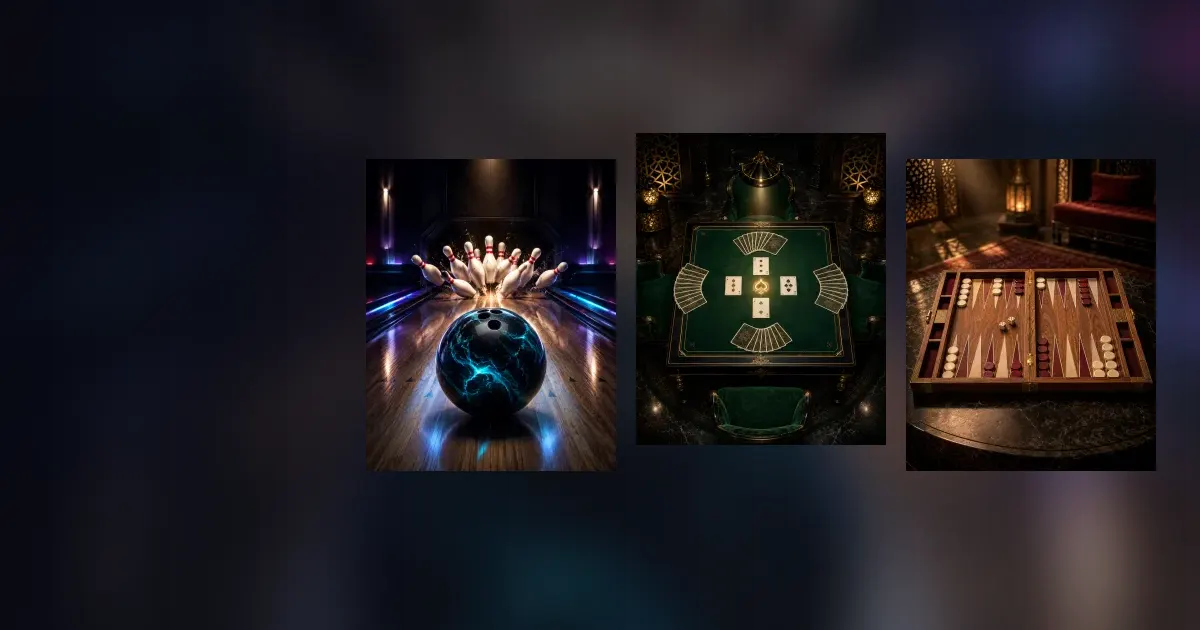
3D Bowling on AsNard is a drag-and-release game: you build the line, the power and the hook of the ball yourself, and physics settles the rest — the same physics that runs on the server, not a pre-scripted animation. That is exactly why a score of 300 is reachable and why a mistake still means something.
This guide goes from zero to strike: reading the line, adding hook, counting the score, and the four modes, each of which works to a different logic.
Game specifications
| Players | 1 to 4 |
| Match length | 5 to 15 minutes |
| Maximum score | 300 (ten frames, all strikes) |
| Skill versus luck | around 80% skill |
| Controls | Drag your finger along the lane, or press the throw button |
| Ranking | Ranked mode with its own ELO |
The anatomy of a throw
Every throw has three variables, and most mistakes come from one of them:
- Position on the lane: where you release the ball sets the angle at which it reaches the pins.
- Power and release timing: keep the power marker inside the right range. More power usually costs you accuracy rather than adding points.
- Hook: with a left or right curve, the ball cuts in over the last few metres and meets the pins at a better angle.
Why a strike does not come from rolling straight
The target is not the middle of the formation; it is the pocket: the gap between pin 1 and pin 3 for a right-hander, and between pin 1 and pin 2 for a left-hander. If the ball enters that pocket at an angle, the pins react in a longer chain and the chance of a strike goes up. A dead-head hit usually knocks pin 1 away and leaves the rest standing.
So in your first practice sessions, focus on where the ball makes contact instead of throwing harder. One gentle hook with a well-timed release beats ten unplanned throws.
Strikes, spares and the way points are counted
- Strike: all ten pins on the first ball. Its value depends on your next two throws, which is why back-to-back strikes are worth several times more.
- Spare: clearing the lane on the second ball. It takes one bonus throw from the next frame.
- Open frame: if pins are still standing after two throws, you score exactly that many and the frame closes.
- The tenth frame: a strike or a spare earns you bonus throws; this final frame is usually what separates 180 from 200.
The four game modes
| Mode | What changes |
| Classic | The standard ten frames, up to the 300 ceiling |
| Bomb Party | Special pins and explosive scores; a swingier round |
| Trick Shot | Unusual pin setups and creative throws |
| Pin Battle | A pin-elimination duel between two players, not a race against the scoresheet |
Mistakes new players make
- Always at full power: higher speed magnifies any line error, and the ball ends up in the gutter.
- Releasing too early: the direction of your drag matters more than its length. Let go too soon and the ball drifts off line.
- Ignoring the hook: without curve the ball travels flat and hits pin 1 instead of the pocket.
- Underestimating spares: a decent average is built from spares, not from the occasional random strike.
How to improve faster
- Play three frames working only on your release point. Keep the power fixed and change one variable at a time.
- Pick one light hook and repeat only that on your next ten throws.
- Switch to practice mode and, after each frame, look at where the ball failed: the edge of the lane or the middle.
- Once your average climbs past 120, sit down at a ranked table. The opponents there are at your level.
What is different about AsNard
- The physics of the ball and the pins runs server-side, so a result cannot be tampered with.
- You can change your ball's skin and colour from the shop, and it has no effect on play — it is appearance only.
- Voice chat is active in the bowling room, so you can play and talk with a friend at the same time.
- If your connection drops, your seat is held for a short while so you can return to the same table.
If you have not tried bowling yet, the 3D Bowling page takes you straight into a lobby — free, and with nothing to install.